


February came the announcement from the Norwegian Tourist Association, DNT: “More than 19 winter routes on the Hardangervidda will not be cleared in winter/spring 2026, and six cabins will be closed.
This applies to Kalhovd, Stordalsbu, Helberghytta, Lågaros, Torehytten and Hadlaskard”.
Wild reindeer – Rangifer tarandus
The background is that one of Norway’s wild reindeer populations is severely endangered. This is also almost the entire population of wild reindeer in Europe, so Norway has a special responsibility: wild reindeer are considered a species of responsibility in Norwegian nature management.
This term is not used in the Nature Diversity Act, but the meaning and the accompanying special responsibility that lies with Norwegian nature management follows from the wording, a species of responsibility is a species that “… has a significant proportion of its natural distribution or genetic characteristics in Norway”. “… a significant proportion …” is often considered a starting point of about 25%. The Norwegian wild reindeer – the remnants of the European mountain reindeer or tundra reindeer tribe, are far beyond this. Norway is the only country in Europe left with independent tribes of this wild reindeer.

All areas with wild reindeer tribes are located in southern Norway, from Setesdalen to Sør-Trøndelag. Altogether, it is estimated that there are a total of 15-20,000 wild reindeer left on the Norwegian mainland. The Svalbard reindeer is the same species as the mountain reindeer, but is somewhat different as another subspecies. With the exception of a small tribe on the Kola Peninsula, it is the remnants of the once large European tribe of wild reindeer. Of the Norwegian wild reindeer, about 8,000 of them migrate on the Hardangervidda plateau.
The ongoing, and largely man-made, climate change is exposing the wild reindeer tribe to many problems. Not only that, over the past hundred years, humans have removed, built up and restricted biotopes and areas that were previously essential for the Norwegian wild reindeer population. This has forced the population into increasingly smaller and more marginal areas, surrounded by traffic and other human activity all year round.

And as if that were not enough, climate change is causing the snow to melt and freeze into a hard layer of ice on the ground in winter. The ice layer makes it virtually impossible for the reindeer to dig down to reindeer lichen and other food. In summer, the warmer climate causes the glaciers to melt, and parasites and insects follow them up into the mountains. Many of us have also been affected by the scurvy disease that has affected the wild reindeer population. Scurvy is a prion-based fatal disease for cervids, and is virtually impossible to stop once it has entered the population. The wild reindeer in Norway have long been on the red list, and are classified as near threatened.
Hiking on the plateau
During the year, the wild reindeer herd migrates across large parts of the plateau, and one of the major challenges in the management of the Norwegian herd today is to create corridors and overlaps between the different areas, such as the Hardangervidda, Breheimen and Rondane. This is not least important to ensure genetic diversity and prevent extensive inbreeding in the herd.
One of the most important limitations is the traffic of people who crisscross the wild reindeer areas. The herd’s movements throughout the year reflect not only seasonal variations in access to food, but also seasonal variations in the herd’s biological life.
With Easter and spring come the migrations to find places for the spring calving, and there is a great need to ensure the herd’s peace and quiet during this period. The landowners in the areas on the Hardangervidda have therefore set limits on DNT’s marking of winter trails through critical areas on the plateau. This has resulted in 19 winter trails not being groomed and marked on the Hardangervidda plateau this year. Wise if you ask me.
One of the central transport infrastructures that runs like a long open wound across the Hardangervidda plateau is Highway 7. From Haugastøl to Eidfjord and Granvin, with Vøringsfossen and the Hardanger Bridge, it is popular as a travel route and as a destination in itself. More unnoticed for many is that you pass Sysendalen and the mountain village of Maurset on the border with the high mountains directly opposite Vøringsfossen. Here you live close to the stories of the wild reindeer tribe on the Hardangervidda plateau. Very close.
With a snort and a sniff
Harding fiddle musician and composer Benedicte Maurseth has created new strong stories about the tribe of Rangifer tarandus tarandus on the Hardangervidda plateau. The stories are told in the work Mirra – if I understand it correctly, this is a dialectical expression, a verb, which can be equated with ‘myldre’, the swarming, the swarming, of reindeer on the Hardangervidda plateau. For our Swedish readers: myllra, myllrade, for Danish readers: myldrede or vrimlede. The work follows her stunning tribute to nature Hárr, to Hårteigen on the Hardangervidda plateau.
I was lucky enough to hear the project Mirra at its launch during last year’s Punktfestival in Kristiansand. The work describes the migrations of the wild reindeer herd on the plateau over the course of a year; from winter grazing on the Eastern Plateau, calving in the spring, the migrations to summer grazing west of the watershed, before the reindeer return to their winter areas. Mirra is a wonderful tribute to the red-listed wild reindeer herd on the Hardangervidda.

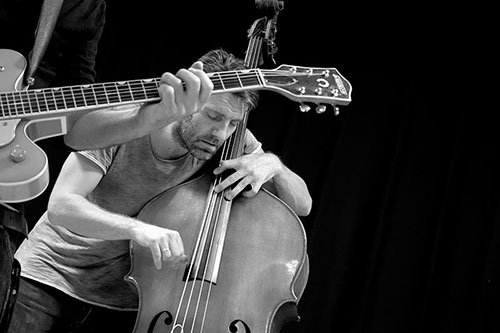
It starts with the wild reindeer on the winter pasture, and recordings of the reindeer’s bleating, snorting, almost grunting. Fvvvvrrrrhhhffff! Fvvvvrrrrhhhffff! Fvvvvrrrrhhhffff!. The scraping of the hooves against the ground, skrrr!, skrrr!, skrrr!. “Mirra” — the reindeer herd moves quickly in search of winter pasture. Mats Eilertsen on double bass and electric bass, Håkon Stene on melodic and other percussion.
A frame drum with rolling balls can evoke good spirits in the hands of a shaman, but they can also create many illusions. Like the sounds on the winter mountain on a day when the temperature is dropping and the old man in the Alvdal village would snap his finger on the thermometer as Kjell Aukrust has so vividly described it. Morten Qvenild on keyboards, synths and other electronics, as well as the jazz scene’s Steinway grand piano.

The last time I saw and heard Qvenild he was wearing a bear hat, a scooter suit from UNIS, the university center in Longyearbyen, and thick underpants, on top of a pingo, where he and his fellow musicians created evocative music as a warning and tribute to a nature in change due to humanity’s negligence. This makes for a long link from this Saturday a week and a half ago, the Glacier Lamentation project and what is unfolding before my eyes and ears.
We are experiencing a musical calving, on the spring pasture, “The Calf Rises”. It seeks the warmth and reassuring protection of the reindeer, and the rich milk that is the purest elixir of life. At “Sommerbeite” life is easy and the nights are bright. Summer is coming to an end and large quantities of “Kvitkrull”, the reindeer moss that is perhaps the most central part of the wild reindeer’s diet, are blooming.

If you are clean, you are pretty
What is an individual, some of us may often wonder. For the certainty that we are not one, but many, almost infinitely many, is striking and overwhelming. What you experience as you is not one you, but a large and diverse, symbiotic community. Without this community there would be no you. This is also the case with the wild reindeer, as it is probably the case with all other species that roam the planet we call our common home, and whose sustainability we are apparently willing to do whatever we can to undermine. The reindeer has a rich bacterial flora in its digestive system, which means that up to 90% of the carbohydrates in the white hair are absorbed as nutrition. A reindeer is not a reindeer, a reindeer reindeer.
Autumn is coming, and thus the autumn hunt. And this is not a fox hunt. “Hunting march”. Should we continue hunting the tribe? And why? The hunt ended on September 21. Then winter begins. “Fresh snow over reindeer lichen”. The fight for existence is hard and tough. But the mountain reindeer are some tough guys. The rutting season begins, the fight to continue existence. Survival of the fittest, the formulation that has entered everyday language in many languages. The animal that has genes that enable it to exploit the resources in the ecological niches in which the mountain reindeer live, that can assert itself best, is the one that passes on its genes over generations.
The selfish gene
That’s what Richard Dawkins called it in his book – The Selfish Gene – which everyone should read. Evolution is not a struggle between individuals of a species for survival. It is the gene, the hereditary material, that is We can discuss up and down the columns about how Dawkins’ writings developed further. But there is no doubt that the first book has qualities that make it a book that belongs in every private library, and there it should be characterized by donkey ears and marrow remarks and comments. If you read it, you will also learn what a meme really is – and that it can be far more important and more powerful than all the world’s tattered cat pictures, jokes and satire.
To conclude the concert, Maurseth brings out two songs from Hárr, “Reinsdyrbjøller” and “Hreinn”. We land softly and warmly after a captivating and strong nature experience – a strong experience of what music’s storytelling power can be – what it should be.
One can only hope that those who set the premises for the policies we are pursuing against an increasingly dangerous climate situation, and a still threatened nature, listen.
As an encore, we get the closing song on the album Mirra, “Simleflok under månen”. The simles have now grown antlers to protect the calves and the herd, after the bucks have swept their antlers after the rutting period. Here we leave the herd, when the circle is closed, the annual cycle is complete, and a new generation of calves will be born in the coming spring.


