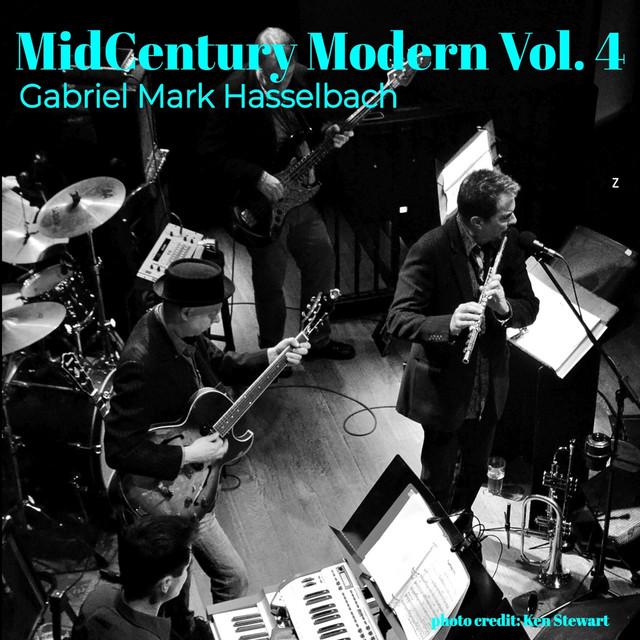
The Timeless Language of Hard Bop, Soul and Swing! An exuberant celebration of classic jazz, trumpet tradition and the enduring beauty of musical reinvention.
There is something wonderfully enduring about the sound of a jazz trumpet. A single note can evoke the glow of a late-night club, the excitement of a crowded dance floor, the smoky intimacy of a small ensemble, or the unrestrained joy of musicians discovering something extraordinary in the moment. In the hands of a truly versatile artist, the trumpet becomes more than an instrument: it becomes a voice capable of laughter, tenderness, swagger, melancholy and exhilarating freedom. Canadian multi-instrumentalist Gabriel Mark Hasselbach understands this expressive language profoundly, and with MidCentury Modern, Vol. 4, he returns to the foundations of classic jazz with a spirit that is at once affectionate, adventurous and unmistakably contemporary.
Released on April 20, 2026, this substantial collection brings together twenty tracks across approximately one hour and forty-nine minutes, opening a generous window into Hasselbach’s appreciation of the hard-bop tradition, soul jazz, blues-inflected improvisation and the swinging musical culture that shaped generations of modern instrumentalists. The album is not simply an exercise in nostalgia. Instead, it presents the music of an earlier era as a living, breathing art form, one that can be revisited, reinterpreted and refreshed by musicians who understand both its historical significance and its continuing emotional power.
Hasselbach’s approach is rooted in a conviction that jazz history is not a museum of untouchable masterpieces. It is a conversation between generations, a succession of personal voices responding to rhythms, harmonies and ideas that never truly lose their relevance. Through this fourth instalment of the MidCentury Modern series, he celebrates the composers, instrumentalists and bandleaders whose work helped establish the vocabulary of modern jazz, while allowing his own personality to emerge through the phrasing, tonal colours and rhythmic vitality of the performances.
The result is an album that invites listeners into a world of swinging horns, elegant piano voicings, deeply grounded bass lines and percussion that can shift effortlessly between a delicate whisper and a jubilant rhythmic declaration. Its atmosphere is warm and welcoming, but the musicianship behind that accessibility is anything but casual. The music draws its strength from the precision of the ensemble, the subtlety of its arrangements and the freedom that comes when experienced musicians share a common understanding of the jazz tradition.
A musician with many voices
Gabriel Mark Hasselbach’s musical identity is particularly fascinating because it cannot be confined to a single instrumental personality. A trumpeter, flugelhornist, flutist and valve trombonist, he approaches jazz through a broad spectrum of tonal possibilities. Each instrument offers a different emotional landscape, and the art lies in knowing not only how to play it, but when its particular voice can illuminate a musical idea.
The trumpet is naturally associated with brilliance, projection and the capacity to cut through a dense ensemble texture. It can deliver a sharp, declarative phrase or unfold a long, lyrical line with remarkable expressive control. In hard bop, where rhythmic urgency often meets blues feeling and sophisticated harmonic movement, the trumpet has historically occupied a central role. Hasselbach’s engagement with this tradition allows him to explore its characteristic combination of technical fluency, melodic invention and direct emotional communication.
The flugelhorn offers a contrasting perspective. Its darker, rounder and more velvety tone is particularly suited to reflective melodies, softly contoured phrases and the kind of lyrical improvisation that seems to emerge from the natural rhythm of breathing. Where the trumpet can announce an idea with confidence, the flugelhorn can make that same idea feel intimate, almost conversational. It belongs to the quieter side of jazz, where the space between notes becomes as meaningful as the notes themselves.
The flute introduces another dimension, bringing brightness, delicacy and a sense of airiness to the instrumental palette. Its sound can glide above the rhythm section, adding a graceful melodic contour or creating a striking contrast with the weight and warmth of brass. Meanwhile, the valve trombone broadens the possibilities further, combining the flexible phrasing of a valved instrument with a distinctive brass character that can be playful, mellow or assertive.
What makes this multiplicity meaningful is not the mere demonstration of instrumental skill. It is the artistic understanding that different sounds reveal different aspects of the same musical world. Hasselbach’s career has developed around this versatility, allowing him to move between straight-ahead jazz, blues, soul jazz, funk and contemporary instrumental music without treating them as separate territories.
His experience as a recording artist and performer gives this album an additional sense of purpose. Rather than approaching classic jazz as a style to be reproduced mechanically, he brings the perspective of a musician who has spent decades exploring the relationship between tradition and individual expression. The music becomes a meeting place for inherited vocabulary and personal interpretation.
The spirit of hard bop and the soul of a generation
The title MidCentury Modern evokes a period when jazz was undergoing extraordinary creative expansion. During the 1950s and 1960s, hard bop developed into one of the most influential approaches in modern jazz, drawing on bebop’s harmonic sophistication while reconnecting the music with blues, gospel, rhythm and blues, and the visceral energy of Black American musical traditions.
The sound could be intellectually demanding without sacrificing its physical appeal. Complex chord progressions and fleet improvisations existed alongside earthy grooves, memorable melodies and rhythmic patterns that invited movement. The best hard-bop performances possessed an unmistakable balance between discipline and spontaneity: every musician understood the architecture of the music, yet within that framework there was room for surprise, humour, risk and discovery.
Hasselbach’s album celebrates precisely this balance. Its repertoire includes material associated with influential trumpet voices and classic jazz composers, with connections to the musical worlds of Carmell Jones, Joe Gordon, Freddie Hubbard and Blue Mitchell. Their legacies represent different facets of the tradition, from melodic clarity and lyrical warmth to explosive virtuosity and rhythmically charged improvisation.
There is an important distinction between reverence and imitation. A musician may reproduce the surface characteristics of an earlier style while leaving its deeper meaning untouched. The more compelling approach is to understand what made that music vital in the first place: the interaction of personalities, the conversation between soloist and rhythm section, the ability to make a familiar chord progression sound newly discovered.
MidCentury Modern, Vol. 4 finds its artistic identity in this second approach. Its classic vocabulary is a starting point for expression rather than a set of restrictions. Swing remains central, but it is never merely a metronomic sensation. It is a collective impulse, an elasticity of time that allows the musicians to lean into a phrase, delay a resolution, answer a rhythmic accent or turn a simple melodic figure into a lively exchange.
That is why the album’s traditional orientation does not make it feel remote from contemporary listeners. The musical language may have been forged decades ago, but its pleasures remain immediate. The blues still speaks directly to human experience. A well-shaped trumpet phrase can still communicate joy or longing without a single word. And a rhythm section that swings with conviction can still transform a room, whether the listener is sitting attentively with headphones or imagining the atmosphere of a bustling jazz club.
Opening the door: “Terra Firma Irma”
The album begins with “Terra Firma Irma,” a title that suggests groundedness, stability and a certain playful sense of character. As an opening statement, it establishes the record’s commitment to melody, swing and the kind of confident ensemble playing that makes classic small-group jazz so enduring.
The essential attraction of a performance such as this lies in the relationship between the lead horn and the rhythmic foundation beneath it. A strong melody needs room to breathe, but it also benefits from the gentle pressure of a rhythm section that keeps the music moving forward. Piano, bass and drums create the framework within which the horn can shape its phrases, adding accents, variations and unexpected turns without losing sight of the central musical idea.
Hasselbach’s artistic strength lies in the ability to make virtuosity feel conversational. The most persuasive jazz improvisation is not a catalogue of technical accomplishments; it is a story told through rhythm, articulation and melodic development. A phrase establishes a thought, another extends it, and a third may overturn expectations altogether. The listener follows this process almost as if listening to a conversation between people whose personalities become more apparent with every exchange.
“Terra Firma Irma” establishes an inviting point of entry into the album’s larger world. It offers a reminder that classic jazz can be sophisticated and immediately enjoyable at the same time, and that the most durable musical ideas often thrive on clarity rather than unnecessary complication.
“Chick’s Tune”: the pleasure of a groove
“Chick’s Tune” continues the journey through a rhythmic landscape in which the interplay between drums, bass, piano and horn becomes a source of constant momentum. There is a particular pleasure in hearing a compact jazz ensemble establish a groove and then explore its possibilities from within.
The rhythm section is not simply accompanying the soloist. It is an active participant in the unfolding drama. The drummer can sharpen a phrase with a crisp accent or soften the texture with a lighter touch; the bassist can reinforce the harmonic foundation while adding movement between the chords; and the pianist can alternate between supportive voicings, rhythmic punctuation and melodic responses.
Such interaction gives the music its characteristic feeling of forward motion. The beat remains stable, yet the surface is alive with tiny changes in emphasis and timing. Swing emerges from the relationship between these elements, not from the repetition of a fixed pattern.
Hasselbach’s trumpet-oriented approach to this repertoire places melody at the centre of the experience. The horn can lead, challenge, tease and respond, allowing the performance to develop organically rather than following a rigid sequence of predetermined gestures. This is the language of musicians who appreciate the value of listening as much as playing.
“Mamacita” and the colour of Latin-inflected jazz
With “Mamacita,” the album turns towards a more rhythmically buoyant atmosphere. Latin-inflected jazz has long occupied a special place in the music’s development, introducing rhythmic patterns and accents that can transform the character of a familiar harmonic progression.
The attraction is not simply a change of beat. Latin jazz creates a different relationship between melody and pulse, encouraging phrases to move with a new sense of lift, syncopation and rhythmic precision. The music can feel playful without becoming lightweight, and sophisticated without losing its immediate appeal.
For a horn player, such a setting offers an opportunity to explore articulation and phrasing in particularly vivid ways. A short, sharply defined motif can become the foundation for an extended improvisation, while a longer melodic line may float above the rhythmic pattern, creating a pleasing contrast between continuity and movement.
The broader lesson is that jazz has always flourished through exchange. Its history includes encounters between musical cultures, rhythmic traditions and individual voices, each contributing something new to the evolving language. A piece such as “Mamacita” belongs to this expansive spirit, reminding us that the jazz tradition is most compelling when it remains open to movement and discovery.
“Driftin’”: a meeting of horn voices
The inclusion of Cory Weeds on “Driftin’” adds another important dimension to the album. Weeds, known for his work as a tenor saxophonist and his deep involvement in the Canadian jazz scene, brings a contrasting horn voice to the ensemble.
The meeting of trumpet and tenor saxophone has long been one of jazz’s most stimulating combinations. Their timbres differ in weight, attack and resonance, and those differences can create a vivid musical dialogue. The trumpet may offer a sharply outlined melodic statement, while the tenor saxophone responds with a broader, more breath-driven phrase. One instrument can establish a rhythmic idea that the other develops or playfully disrupts.
This contrast is especially effective in straight-ahead jazz, where the pleasure of improvisation comes from hearing individual personalities interact within a shared framework. The musicians do not need to sound alike. Their differences are precisely what make the conversation interesting.
“Driftin’” also suggests the importance of ease in jazz performance. The title evokes movement without strain, a sense of travelling through a groove while remaining alert to every change in the musical landscape. That apparent ease is often the product of considerable experience: a deep familiarity with the harmony, a secure rhythmic foundation and the confidence to let a phrase unfold naturally.
The result is a meeting of musical sensibilities that complements the album’s central idea. Tradition becomes richer when it is shared, and a familiar jazz vocabulary acquires new dimensions when interpreted by musicians with distinctive voices.
“Superblue” and the language of soul jazz
“Superblue,” featuring pianist Miles Black, brings attention to one of the defining characteristics of Hasselbach’s musical world: the connection between jazz sophistication and the visceral appeal of soul.
Soul jazz emerged from the recognition that harmonic ingenuity and rhythmic directness need not be opposing forces. The music could contain the improvisational complexity of modern jazz while retaining the physical immediacy of blues, gospel and rhythm and blues. It could be elegant without becoming distant, and earthy without sacrificing sophistication.
The piano is crucial to this balance. Its chords establish harmonic colour, but their placement also influences the groove. A slightly delayed chord, a sharply accented response or a sequence of blues-inflected voicings can alter the emotional character of an entire passage.
Black’s presence offers a valuable counterpart to Hasselbach’s horn. Piano and trumpet have a long history of fruitful exchange in jazz, with the pianist providing both harmonic support and a melodic interlocutor. The relationship becomes particularly expressive when the two players leave room for each other, allowing a solo to develop without overcrowding the musical space.
“Superblue” belongs to the part of the jazz tradition where blues feeling and instrumental finesse meet naturally. The music does not need to announce its emotional purpose. It communicates through the shape of a phrase, the warmth of a chord and the unmistakable satisfaction of a groove that settles into place.
“Jazz’n’Samba”: a dance of rhythm and melody
Few combinations demonstrate jazz’s capacity for reinvention more clearly than the meeting of improvisation and samba. The rhythmic vocabulary of Brazilian music offers a different kind of propulsion, one that can make a jazz ensemble feel lighter, more fluid and subtly more intricate.
“Jazz’n’Samba” brings this rhythmic sensibility into the album’s wider celebration of classic jazz. The attraction lies in the relationship between pulse and phrasing. A melody can stretch across the rhythm, anticipate an accent or arrive just after the listener expects it. These small shifts create a sense of movement that is both controlled and spontaneous.
For a horn player, the challenge is to maintain melodic clarity while responding to the rhythmic character of the accompaniment. The notes must dance, but they must also speak. Hasselbach’s broad instrumental experience makes this kind of expressive flexibility central to his musical identity.
The piece also underlines a defining feature of the album: its variety. Rather than presenting a single mood or tempo for an extended period, the programme moves between contrasting rhythmic environments, allowing each selection to reveal a different aspect of the tradition.
“Blues On My Mind”: the emotional foundation
The blues remains one of the most enduring sources of meaning in jazz. Its vocabulary is familiar, but its expressive possibilities are almost limitless. A bent note, a repeated phrase or a pause before a resolution can communicate more than an elaborate sequence of technical gestures.
“Blues On My Mind” places that emotional language at the centre of the listening experience. The title suggests a reflective mood, but the blues is never confined to sadness. It can carry humour, resilience, desire, frustration and celebration, sometimes within the same musical phrase.
The expressive challenge for a trumpeter is to make the instrument sound as though it is speaking. This requires more than accurate intonation or speed. It depends on articulation, tonal control and the ability to shape a phrase with the natural rise and fall of a human voice.
The blues also offers a particularly welcoming environment for ensemble communication. A repeated harmonic pattern gives musicians a common reference point, allowing them to concentrate on subtle variations in phrasing and interaction. The familiar framework becomes a source of freedom rather than a limitation.
In this sense, the blues is not an occasional flavour added to the album. It is part of the underlying language through which Hasselbach approaches jazz itself.
“Gibraltar”: strength, space and musical architecture
“Gibraltar,” another selection featuring Miles Black, introduces a title that suggests solidity and a strong sense of place. In a jazz setting, that impression can be expressed through a firmly articulated groove, a memorable melodic contour or a harmonic structure that gives the improvisation a clear sense of direction.
The piano’s role is again central. It can establish the architectural framework of a piece while simultaneously introducing colour and movement. A pianist who understands the relationship between harmony and rhythm can make even a relatively simple progression feel alive, shaping the music’s atmosphere through the placement and voicing of chords.
Against this foundation, Hasselbach’s horn can explore melodic ideas with both confidence and flexibility. The strongest improvisations often possess a clear internal logic: each phrase seems to grow out of what came before, while leaving enough uncertainty to keep the listener engaged.
This interplay between structure and spontaneity lies at the heart of classic jazz. The musicians know where the music is going, but they do not know exactly how they will arrive there. That is the essence of improvisational creativity.
“So What… Now?”: tradition answering the present
The title “So What… Now?” playfully suggests a conversation with one of the most recognisable compositions in modern jazz: Miles Davis’s “So What.” Rather than treating the past as a closed chapter, the title opens the possibility of asking what its musical ideas can mean in a different setting.
Davis’s composition became emblematic of modal jazz, with its spacious harmonic framework inviting musicians to explore melodic possibilities without the constant pressure of rapid chord changes. Its influence extends far beyond a single recording, reaching into the broader understanding of space, repetition and improvisational freedom.
The question implied by Hasselbach’s title is particularly appropriate for an album concerned with the relationship between heritage and contemporary expression. What happens when a musician takes a familiar point of reference and approaches it with a new perspective? How does an established jazz language change when it passes through another artist’s imagination?
The answer lies in interpretation. A successful reimagining does not need to erase the original’s identity. Instead, it finds a way to make the material speak differently. The melody, rhythmic placement and instrumental colour can reveal details that were previously less prominent, while the performer retains a sense of respect for the music’s history.
In a programme filled with references to classic jazz, “So What… Now?” becomes a particularly fitting statement of intent. The past is present, but the music continues to move forward.
“Blue Soul” and “Funk in Deepfreeze”: the groove expands
“Blue Soul” continues the album’s exploration of the meeting between blues feeling and soulful jazz expression. Its title captures a sensibility that has been central to many of the most enduring jazz recordings: the belief that sophisticated musicianship can coexist with warmth, directness and a powerful rhythmic centre.
Soulful jazz depends on the collective sound of the ensemble. The horn may be the most immediately noticeable voice, but the groove is created through the combined contributions of every musician. The bassist provides direction, the drummer shapes the pulse, and the pianist fills the harmonic landscape with colour and movement. Each element contributes to a sound that feels unified without becoming uniform.
“Funk in Deepfreeze” takes this exploration into a more overtly groove-oriented environment. Its significance is reinforced by a notable guest lineup that includes pianist Jeff Lorber, guitarist Chuck Loeb, bassist Brian Bromberg and drummer Gary Novak.
The presence of these musicians connects the album’s classic-jazz orientation with the broader world of contemporary instrumental music. Funk offers a distinctive approach to rhythmic organisation, relying on tightly coordinated patterns, carefully placed accents and the interaction between bass and drums. The groove can be intricate without sounding complicated, and its power often depends on restraint as much as energy.
In such a setting, the horn must find its place within a dense rhythmic structure while retaining its own melodic personality. A sharply defined phrase can cut through the groove, while a more relaxed melodic line can ride above it. The interplay between precision and freedom gives funk-inflected jazz its particular excitement.
The inclusion of this ensemble also reinforces Hasselbach’s refusal to draw rigid boundaries between musical generations. Classic jazz and contemporary groove are not rival philosophies. They are different ways of organising rhythm, harmony and improvisation, and both can be enriched through an open-minded approach.
“Sister Sadie”: a tribute to hard-bop elegance
“Sister Sadie,” associated with pianist Horace Silver, occupies a special place in the hard-bop repertoire. Silver’s music was celebrated for its memorable melodies, blues-based character and infectious rhythmic vitality. He possessed a remarkable ability to make sophisticated jazz compositions feel immediately accessible without reducing their musical substance.
That combination of qualities makes “Sister Sadie” an appropriate choice for Hasselbach’s album. The piece belongs to a tradition in which melody is not merely a starting point for improvisation but a source of enduring identity. A strong theme gives musicians something to return to, allowing each solo to illuminate a different aspect of the composition.
The hard-bop aesthetic also values the collective personality of the band. The rhythm section does not simply maintain the tempo while the horn takes centre stage. It contributes to the character of the performance through rhythmic accents, harmonic responses and carefully judged shifts in intensity.
In revisiting repertoire associated with Silver and his contemporaries, Hasselbach participates in a musical conversation that has continued for generations. The task is not to make the past sound untouched, but to allow its essential qualities to emerge through the sensibility of the present.
“I’m Gonna Go Fishin’”: a lighter touch
Jazz has always made room for wit, charm and a certain mischievous lightness. Not every performance needs to pursue dramatic intensity or deep introspection. Sometimes the most satisfying musical experience is one in which melody, rhythm and ensemble chemistry create an atmosphere of uncomplicated pleasure.
“I’m Gonna Go Fishin’” offers a title that suggests precisely this kind of playful spirit. The appeal of a tune with a strong melodic identity lies in the possibilities it gives the performers: a rhythmic twist here, an unexpected accent there, a melodic variation that transforms a familiar phrase into something fresh.
Such music requires its own form of discipline. Lightness is not the absence of sophistication; it is often the result of musicians who understand their material so thoroughly that they can make complex ideas sound effortless.
Hasselbach’s approach to traditional jazz is well suited to this balance. His instrumental versatility allows him to think in terms of tonal colour and phrasing, while his long engagement with the genre provides a foundation for the kind of relaxed confidence that makes the music inviting.
“Mississippi Jump”: a celebration of brass personality
“Mississippi Jump” points towards another important element in the album’s aesthetic: the theatrical and celebratory side of jazz. The title evokes movement, regional musical associations and the exuberant brass traditions that helped shape the sound of New Orleans and the wider jazz world.
Here, the trumpet’s capacity for personality becomes especially important. Jazz brass can be bold, humorous, declarative or deeply expressive, and some of its greatest performers have understood that a musical phrase can communicate character as effectively as a spoken line.
The history of jazz includes many trumpet players whose identities were inseparable from their sound. Their individuality emerged not simply from technique, but from the way they shaped notes, placed accents and used the instrument to communicate a distinctive personality.
Hasselbach’s engagement with this heritage gives the album a sense of continuity. The trumpet can honour the tradition without becoming trapped by it, allowing historical influences to become part of an individual musical vocabulary.
The piece also reminds listeners that jazz has always been a social art. Its most joyful moments often arise from the relationship between musicians and audience, when rhythmic vitality and expressive personality create a shared sense of excitement.
“Jazz Party”: music as a gathering
The festive spirit becomes explicit with “Jazz Party,” featuring Hasselbach alongside vocalist Deborah Carter, with Glenn Riley on bass and Paul Driver on drums. The presence of a singer introduces another dimension to the album’s exploration of classic jazz. The human voice brings language, breath and the subtleties of verbal expression into a musical environment already rich in instrumental dialogue. A singer can shape a phrase through the timing of a word, the colour of a vowel or a slight change in emphasis, creating a relationship with the rhythm section that differs from instrumental improvisation.
Carter’s participation also strengthens the sense of occasion suggested by the title. A jazz party is not simply a gathering of musicians playing familiar tunes. It is an atmosphere in which musical sophistication and social pleasure reinforce each other, allowing the music to move between listening and celebration.
The ensemble format encourages a more communal sound. The rhythm section provides the foundation, the vocalist becomes a central storyteller, and the horn contributes its own expressive commentary. The result is a reminder that jazz has always encompassed both intimate musical conversation and the energy of collective celebration.
This is one of the album’s most appealing broader ideas: the music need not choose between seriousness and enjoyment. It can be carefully crafted, historically informed and technically accomplished while remaining generous in spirit.
“El Tapatico”: rhythmic curiosity
“El Tapatico” adds another shade to the programme’s rhythmic diversity. Its place within the album reinforces the sense that Hasselbach is interested in the many ways a small jazz ensemble can reshape its sound without abandoning the essential principles of melodic communication and improvisational interaction.
Rhythmic character is one of the most powerful tools available to a jazz musician. A change in accent or phrasing can transform the listener’s perception of a melody, making it feel more playful, more urgent or more reflective. The underlying harmony may remain familiar, yet the music acquires a different physical character.
This is where the ensemble’s shared understanding becomes important. A rhythmic idea must be supported by the bass and drums, coloured by the piano and articulated by the lead instrument. The music feels spontaneous because the musicians respond to one another, but that spontaneity is made possible by an underlying command of the style. “El Tapatico” contributes to the album’s sense of movement, ensuring that the journey through classic jazz remains varied and alive.
“’Round Midnight”: the beauty of restraint
With “’Round Midnight,” the album enters a more introspective emotional space. The composition, written by Thelonious Monk, has become one of the most enduring ballads in jazz, admired for its haunting harmonic language and its ability to suggest loneliness, reflection and nocturnal mystery.
Monk’s music often rewards listeners who are willing to hear beyond conventional expectations. His melodies can contain angular turns, unexpected intervals and rhythmic placements that initially seem unusual, yet these characteristics become the source of their expressive power. In “’Round Midnight,” that individuality is transformed into a deeply atmospheric composition.
The challenge for any interpreter is to preserve the music’s distinctive character while finding a personal way into its emotional world. A ballad does not require a constant stream of notes. Often, the most meaningful gesture is a pause, a gently sustained tone or a phrase that resolves only after the listener has been allowed to sit with its tension.
For Hasselbach, the flugelhorn offers a particularly natural expressive possibility within this kind of repertoire. Its rounded timbre can lend a melody warmth and intimacy, allowing the music to unfold without unnecessary force. The trumpet, too, can become deeply lyrical when the emphasis shifts from brilliance to breath, colour and the shape of a sustained phrase.
“’Round Midnight” provides an important counterbalance to the album’s more buoyant selections. It reminds us that the jazz tradition is not defined by swing alone. Its emotional range extends from exuberant celebration to the most private forms of musical reflection.
“Lullaby of Birdland”: elegance and melodic charm
“Lullaby of Birdland,” associated with composer George Shearing, brings another celebrated standard into the album’s orbit. The composition has enjoyed a long life in jazz because its melodic identity is both distinctive and adaptable. It can be approached with rhythmic sparkle, lyrical elegance or a more relaxed, intimate sensibility.
A standard survives not because it must always sound the same, but because it contains possibilities that different performers can uncover. Its harmonic structure provides a familiar foundation, while its melody invites reinterpretation through phrasing, dynamics and improvisational development.
For a multi-instrumentalist such as Hasselbach, a standard of this kind also highlights the importance of tonal personality. The character of a melody changes according to the instrument that carries it, the register in which it is played and the space left around each phrase.
The piano and rhythm section contribute to this process by shaping the harmonic atmosphere. The accompaniment can remain light and unobtrusive, allowing the melody to shine, or it can introduce rhythmic details that give the performance a more animated character.
“Lullaby of Birdland” therefore belongs naturally within an album that celebrates the continuity of jazz standards and the endless possibilities of individual interpretation.
“Move” — the excitement of live performance
The inclusion of “Move (Live)” adds a different kind of energy to the programme. A live recording carries the possibility of immediacy that distinguishes performance from studio construction. The music exists in real time, shaped by the musicians’ responses to one another and by the atmosphere surrounding the performance.
“Move” has a particularly strong connection to the bebop tradition, with its reputation for speed, rhythmic agility and demanding melodic movement. The piece challenges musicians to combine technical accuracy with a sense of forward momentum. A phrase must be articulated clearly, yet it must also contribute to the larger rhythmic flow.
The most satisfying bebop performances never allow virtuosity to become an end in itself. The rapid lines, unexpected accents and harmonic turns all serve a larger expressive purpose. They create excitement because the musicians make the music feel alive, not because they are simply demonstrating how many notes they can play.
A live interpretation also places greater emphasis on collective responsiveness. The rhythm section must support the soloist while remaining alert to changes in intensity, phrasing and direction. The resulting performance can contain a sense of risk that is part of jazz’s enduring appeal.
Within MidCentury Modern, Vol. 4, “Move (Live)” offers a reminder of the music’s origins in performance spaces where musicians developed their identities night after night, learning to trust their instincts while listening carefully to the people around them.
“Coming Home for Mardi Gras”: a festive farewell
The programme closes with “Coming Home for Mardi Gras,” a title that evokes the celebratory atmosphere of New Orleans and the wider traditions of brass-band music, parade rhythms and communal festivity.
Mardi Gras has long symbolised a meeting of music, movement and collective identity. In New Orleans, jazz has been connected with public celebration from its earliest development, and the city’s musical traditions continue to demonstrate how improvisation can become part of a shared social experience.
As the final selection in a twenty-track programme, “Coming Home for Mardi Gras” provides an apt concluding image. The album has travelled through hard bop, soul jazz, blues, Latin-inflected rhythms, standards and more contemporary groove-oriented territory. Its final destination is not a rigid definition of jazz, but a celebration of the music’s capacity to bring different styles and moods together.
The notion of coming home is especially resonant in a project devoted to musical heritage. For Hasselbach, the past is a source of inspiration rather than a destination from which no further journey is possible. Returning to classic jazz means reconnecting with the values that made it compelling: rhythmic vitality, melodic imagination, expressive individuality and the freedom to communicate through sound.
The final track therefore feels thematically appropriate. It suggests that jazz’s deepest traditions remain alive whenever musicians bring their own personalities to the music and share the results with an audience.
A cast of musicians united by musical understanding
Although Hasselbach’s horn playing is the central focus, the album’s identity depends on the musicians surrounding him. The core ensemble includes pianist Miles Black, bassist Lawrence Mollerup and drummer Joel Fountain, whose combined roles provide the harmonic, rhythmic and structural foundation for much of the programme.
The piano is especially important in a record such as this. It can support the melody, establish the harmony, create rhythmic punctuation and offer its own improvisational voice. A pianist working in the hard-bop tradition must balance sophistication with directness, making the harmony clear without crowding the soloist or disrupting the groove.
The bass provides both harmonic grounding and forward movement. Its line connects the chords, supports the rhythmic architecture and helps determine the weight and direction of the ensemble sound. The best bass playing makes the music feel secure while ensuring that it never becomes static.
Drums complete the conversation. The drummer can maintain the pulse, shape the dynamic contour of a performance and respond to the soloist through accents and rhythmic commentary. A subtle change in touch can alter the entire atmosphere of a piece, while a well-placed accent can transform a familiar phrase into an exciting moment of collective discovery.
The guest appearances broaden this musical picture. Cory Weeds adds tenor saxophone to “Driftin’,” while Jeff Lorber, Chuck Loeb, Brian Bromberg and Gary Novak bring their collective experience to “Funk in Deepfreeze.” Deborah Carter’s vocal contribution to “Jazz Party” expands the album’s expressive range beyond instrumental performance.
These varied combinations help prevent the programme from becoming uniform. Different musicians bring different rhythmic instincts, tonal colours and approaches to improvisation. The album’s continuity comes not from making everyone sound alike, but from the shared commitment to melody, groove and musical communication.
The artistic value of returning to the roots
There is a particular significance to an established contemporary musician choosing to devote an album to classic jazz. In a musical culture often dominated by the pressure to produce something immediately novel, a return to the roots can be a meaningful creative statement.
It asks listeners to reconsider the relationship between originality and tradition. Must a musician constantly abandon familiar forms in order to remain relevant? Or can genuine originality emerge from a deeper understanding of the language that has already been developed?
Hasselbach’s answer, as expressed through this project, points towards the second possibility. Innovation does not always require rejecting the past. Sometimes it means discovering new relationships within familiar material, bringing a different instrumental perspective to a standard or allowing a well-known groove to reveal another layer of expressive possibility.
This approach requires more than technical proficiency. It demands historical awareness, stylistic sensitivity and the confidence to let the music speak without overcomplicating it. The performer must understand why a composition works, what gives it character and which elements can be reshaped without losing its identity.
The MidCentury Modern series reflects this commitment to the continuing life of jazz tradition. Its fourth volume makes a case for classic jazz as a language that remains open to interpretation, capable of accommodating different personalities and contemporary sensibilities while retaining its essential qualities.
Gabriel Mark Hasselbach: a career shaped by curiosity
Hasselbach’s broader musical journey provides useful context for understanding this project. Born in Denver, Colorado, and later establishing his home in Burnaby, British Columbia, he developed his professional career through a combination of ensemble work, touring, recording and independent artistic activity. His experience with the multiplatinum Powder Blues Band helped establish an international performing background, while his subsequent solo work expanded his identity as a versatile jazz and contemporary instrumental artist.
Across his career, he has explored different approaches to instrumental music, moving between straight-ahead jazz and contemporary styles. His experience as a multi-wind instrumentalist is central to this evolution, allowing him to approach musical arrangements through the distinctive expressive qualities of trumpet, flugelhorn, flute and valve trombone.
That versatility also reflects a broader understanding of the recording process. A successful album is not only a collection of performances; it is a carefully shaped musical environment in which timbre, rhythm, arrangement and repertoire contribute to a coherent artistic statement.
Hasselbach’s continuing engagement with classic jazz demonstrates the importance of curiosity in a long musical career. Rather than treating artistic development as a linear movement away from earlier influences, he returns to the music that helped shape his understanding of the genre, exploring its possibilities from the perspective of an experienced performer.
This is one reason MidCentury Modern, Vol. 4 feels more substantial than a simple collection of nostalgic interpretations. It is part of an ongoing conversation between the musician he has become and the traditions that first captured his imagination.
A record for jazz listeners of different generations
The album has the potential to appeal to several kinds of listener. For those who grew up with classic hard bop, soul jazz and the great small-group recordings of the mid-twentieth century, it offers the pleasure of hearing familiar musical values approached by a contemporary performer.
For younger listeners, it can serve as an inviting introduction to the rhythmic and melodic language that continues to influence modern jazz. The album’s variety provides numerous points of entry, from blues-based grooves and Latin-inflected rhythms to celebrated standards and more adventurous ensemble settings.
For instrumentalists, the music offers another kind of pleasure: the opportunity to hear how phrasing, articulation, tonal control and rhythmic placement shape a performance. The differences between trumpet, flugelhorn, flute and other brass voices invite attention to the relationship between instrumental technique and expressive intention.
Most importantly, the album does not demand specialist knowledge in order to be enjoyed. Its musical foundations are sophisticated, but its appeal is rooted in qualities that listeners can recognise immediately: a memorable melody, a satisfying groove, an expressive solo and the pleasure of musicians playing together with conviction.
This accessibility is not a compromise. It is one of jazz’s greatest achievements. The music can reward close analytical listening while remaining generous to anyone who simply wants to experience its energy and beauty.
Final reflections: the past, alive in the present
MidCentury Modern, Vol. 4 stands as a celebration of jazz’s enduring capacity for renewal. Through a repertoire that encompasses hard-bop influences, soul jazz, blues, Latin rhythms, standards and groove-oriented contemporary expression, Gabriel Mark Hasselbach creates a musical world in which history and individuality remain closely connected.
The album’s greatest strength is the spirit that unites its different moods. Whether the music moves with the buoyancy of “Jazz’n’Samba,” explores the emotional depth suggested by “’Round Midnight,” celebrates the hard-bop tradition through “Sister Sadie,” or embraces a festive atmosphere in “Coming Home for Mardi Gras,” it returns repeatedly to the central values of melodic communication, rhythmic vitality and expressive freedom.
Hasselbach’s many instrumental voices give this journey additional colour, while the contributions of the ensemble and guest musicians expand its musical vocabulary. The performances draw their character from the interaction between individual expression and collective understanding, reminding us that jazz is at its most compelling when musicians listen as intently as they play.
There is also something quietly important about the album’s title. MidCentury Modern suggests a style associated with a particular historical moment, but the music itself refuses to remain confined to that period. The compositions and traditions celebrated here continue to evolve because each new interpretation introduces another perspective, another emotional nuance and another reason to listen.
That is the enduring promise of jazz: the music can remember its past without surrendering its future. It can honour its masters while encouraging new individuality. It can be intellectually rich and physically exhilarating, deeply rooted and endlessly mobile.
With MidCentury Modern, Vol. 4, Gabriel Mark Hasselbach offers listeners a generous invitation to enter that world. The horns speak with warmth and character, the rhythm section provides a living foundation, and the repertoire moves between reflection, swing, blues feeling and celebration.
Ultimately, this is music that understands the value of keeping a tradition alive through performance rather than preservation alone. Its purpose is not simply to remind us of what jazz once was, but to demonstrate what it can continue to be: expressive, inventive, welcoming and full of life.
The album provides an opportunity to celebrate an artist whose musical curiosity bridges generations and whose commitment to jazz tradition remains inseparable from his individual voice. MidCentury Modern, Vol. 4 is a reminder that the most enduring music does not grow old when it is played with imagination. It becomes a living conversation — and, in the hands of musicians who understand its language, that conversation never truly ends.
By Daniella Bushler